Mono Rail
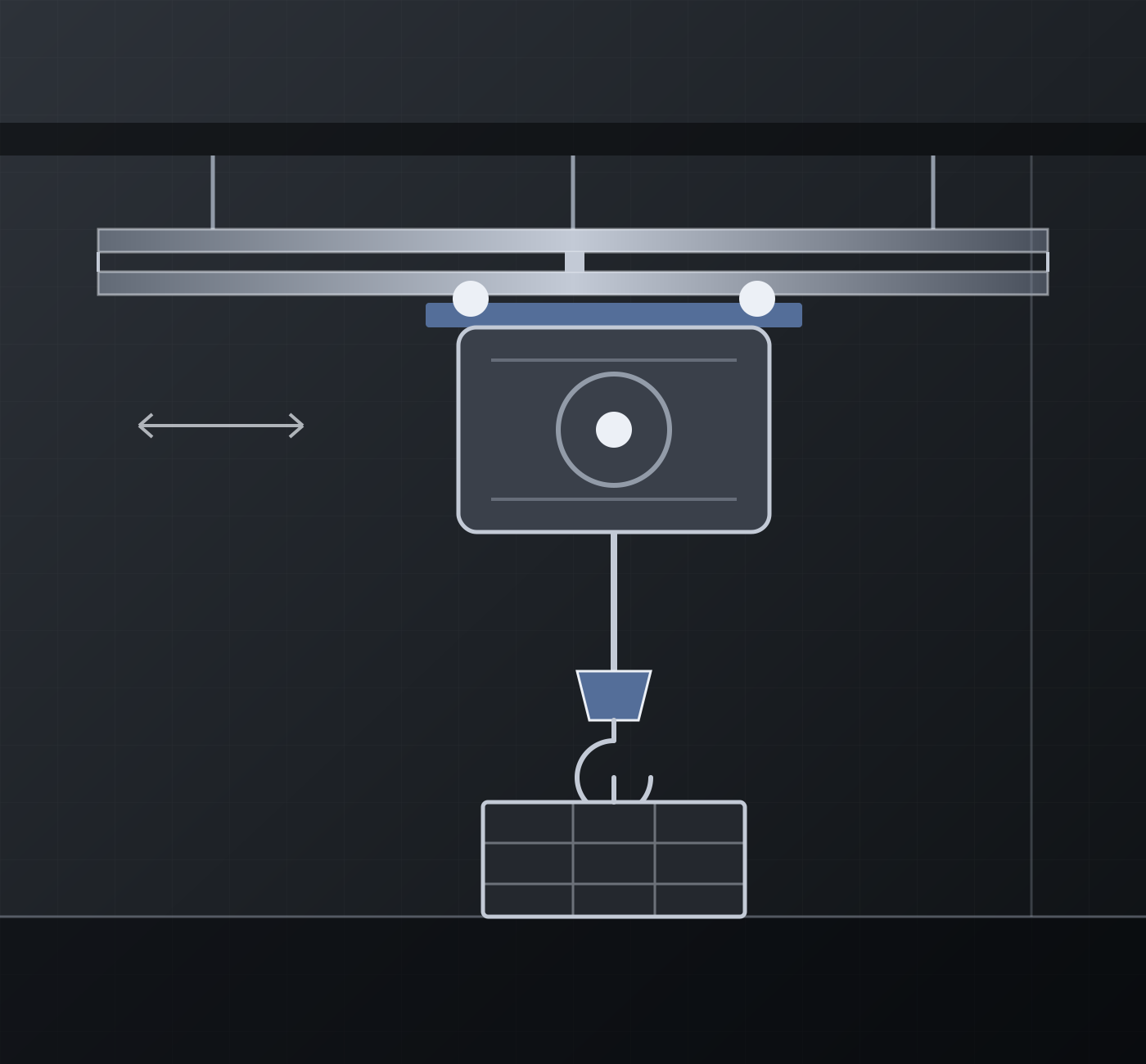
Overhead I-beam track and trolley systems that move loads along a fixed path — simple, strong and economical.
Free site survey · Written quote in one working day
- 01500 kg to 10 tonne capacity
- 02Straight or curved I-beam track
- 03Pendant or radio control
Mono Rail: working principle & applications
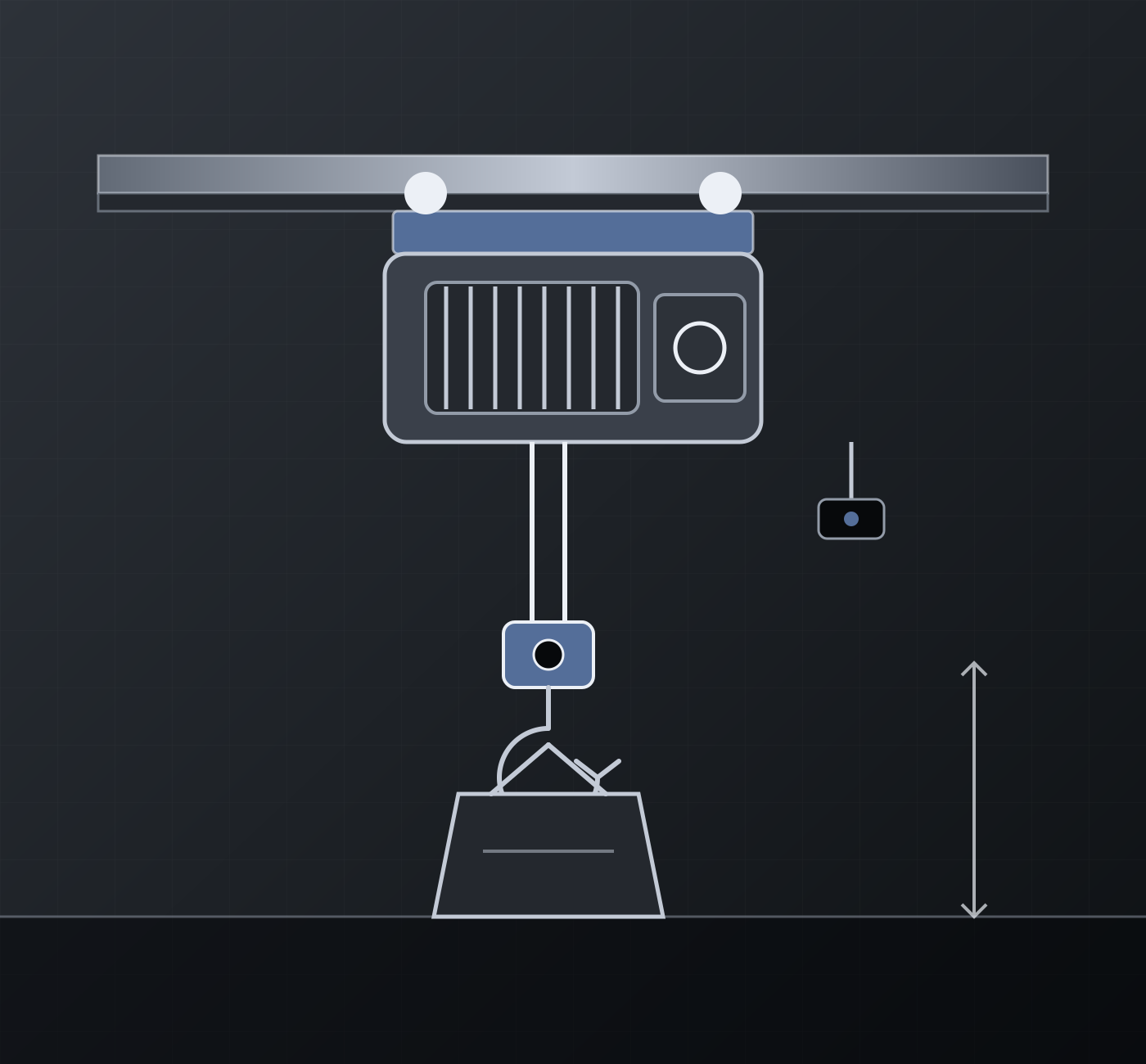
A mono rail system is an overhead track — usually a rolled steel I-beam — along which a hoist trolley travels. The electric hoist lifts the load while the trolley carries it along the beam, giving reliable, repeatable movement between fixed stations without floor space being used.
Track can be straight, curved or switched, supported from the building structure or from free-standing columns. Trolleys may be push-travel, geared or motorised, and hoists can be wire-rope or chain type to suit the load and duty cycle.
Because the path is fixed, mono rails are economical and quick to install, with fewer moving parts than a bridge crane. Beam size, support spacing and end stops are engineered from the load, span and deflection limits so the whole system stays safe and rigid.
Production lines, workshops, assembly bays, foundries, warehouses and maintenance areas.
What you get
Wide capacity range
From light 500 kg duties up to 10 tonne with matched beam and trolley sizing.
Frees up floor space
Overhead track keeps aisles and work areas clear.
Flexible layouts
Straight, curved and switched track designs follow your process flow.
Smooth travel
Precision wheels and rolled beam give quiet, low-effort movement.
Safe by design
Limit switches, end stops, overload device and engineered supports.
Low maintenance
Few components and easy access mean quick, inexpensive servicing.
Mono Rail at a glance
| Parameter | Specification |
|---|---|
| Capacity / rated load | 500 kg to 10,000 kg |
| Hoisting speed | Single speed 4–8 m/min · Dual speed up to 8/1.3 m/min · VFD optional |
| Travel speed | Push-travel, geared (manual) or motorised 10–20 m/min |
| Drive / mechanism | Electric wire-rope or chain hoist on trolley, running on an I-beam track |
| Operation / control | Pendant push-button or wireless radio remote; optional VFD stepless control |
| Track layout | Straight, curved or switched I-beam; ceiling-hung or column-supported |
| Finishes | Epoxy or enamel painted · Galvanised option for harsh conditions |
| Duty class | FEM 1Am / M4 standard; heavier duty on request |
Values are typical and customisable. Final capacity, speed, dimensions and finishes are confirmed after the site survey and approval drawing.
Safety is never optional
- Emergency stop
Mushroom-head emergency stop cuts power to the drive from the control station.
- Overload limiter & end stops
The hoist cuts out above rated load, and travel end stops prevent trolley run-off at track ends.
- Limit switches
Upper and lower travel limits stop motion before the end of the stroke.
- Overload protection
Load-limiting device prevents lifting above rated capacity.
- Guarding & signage
Safety guards, rated-load plates and warning labels as per site requirement.
Questions we get asked
How is a mono rail different from an overhead crane?
A mono rail moves a load along one fixed line. An overhead crane covers an area using a bridge and trolley. Mono rails are simpler and cheaper where the path is fixed.
Can the track be curved?
Yes. Curved and switched sections can be built to follow a process path, with the trolley and beam matched to the radius.
Can it be installed on an existing structure?
Often yes, after a structural check of the roof or frame. Free-standing columns are available if the building cannot carry the load.
Request a custom quote for mono rail
Our engineer measures the site, confirms load, travel and power supply, then puts a written quote in your hands within one working day. No obligation, no call centre.
- Survey booked within 48 hours
- Civil work, power and lead time stated up front
- Installed and serviced by our own team